Wood or Resin? Which hangboards are better
If you're serious about improving your climbing, you've probably wondered: should I train on a wood or resin hangboard?
The answer isn't as simple as 'one is stronger than the other.' The real difference lies in friction, skin wear, and training consistency.
If you've spent any time around rock climbing training, you've likely seen both wood hangboards (also called fingerboards) and synthetic options made from materials like plastic, polyester resin, or polyurethane mounted above a doorway or on a wall. It’s one of the simplest yet most effective tools for building finger strength- arguably the most important physical asset in climbing.
But does the material of your hangboard actually matter?
Can a wood hangboard help you train better than a resin one, or is it simply a matter of personal preference?
What does science say?
From a science perspective, wooden hangboards aren’t ‘magically better’ than resin ones- but they do change the mechanical and biological load on your fingers, which affects comfort, training volume, and injury risk.
1. Gentler on the skin
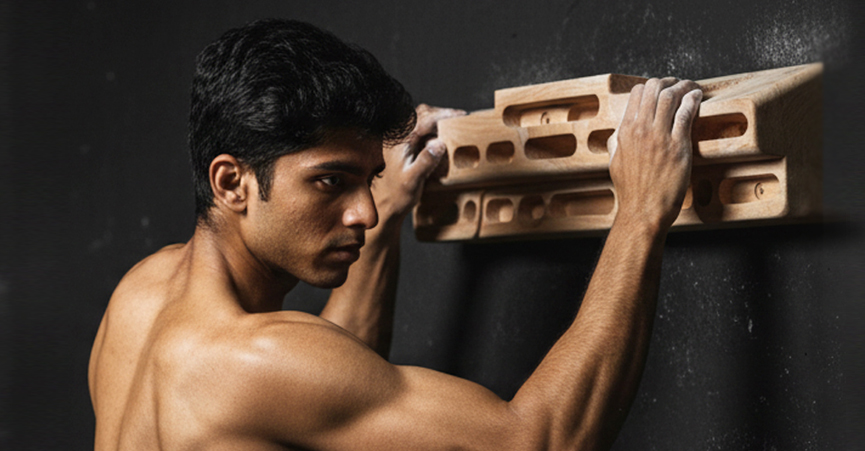
One of the biggest advantages of wooden hangboards is how they feel on your skin.
Climbing grip depends on friction between skin and surface, governed by:
Friction force ≈ coefficient of friction (μ) × normal force
Note: In biomechanics and sports physics, μ is treated as a property of the interaction between skin, surface texture, moisture, and force.
Approximate values are:
• Dry skin on resin: μ ≈ 0.6 - 0.9
• Dry skin on wood: μ ≈ 0.4 - 0.7
• Sweaty skin: μ ≈ 0.2 - 0.5 (reduced friction due to moisture)
• Chalked skin: μ increases by about 0.1 - 0.3 compared to dry conditions, improving grip by enhancing surface contact and reducing slip
Let’s say a climber is doing a dead hang.
Climber body weight = 70 kgs,
Normal force on fingers ≈ weight supported by fingers
So, N = mg = 70 × 9.8 ≈ 686 N
But in real hangboarding, feet may still assist or load may be partial.
So let’s use a more realistic loaded case: Finger load = 400 N
Case A: Wooden Hangboard
Typical effective coefficient of friction: μ ≈ 0.5;
Friction force: F = μN = 0.5 × 400 = 200 N
So, the skin can resist ~200 N of sliding force before slipping.
Case B: Polyester Resin Hangboard (rougher texture)
Typical coefficient: μ ≈ 0.7;
Friction force: F = μN = 0.7 × 400 = 280N
Higher friction → More shear stress on skin → Faster epidermal micro-damage
2. More comfortable for volume training
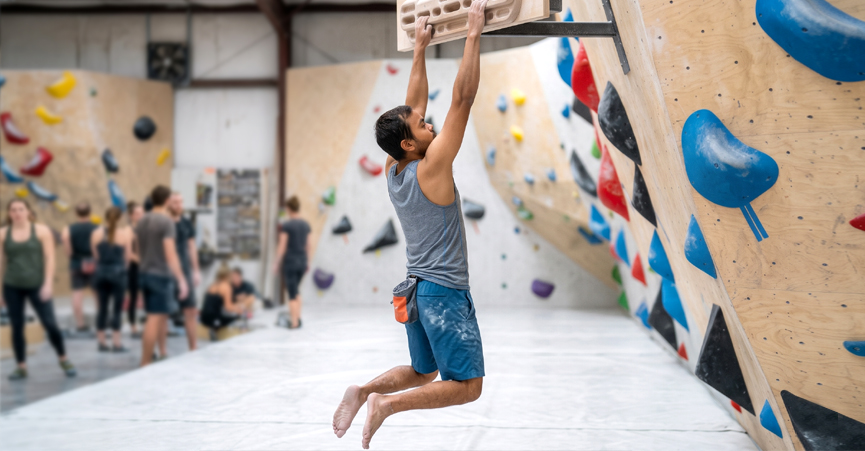
Hangboarding is typically used for structured strength training, such as repeaters, max hangs, or interval workouts.
Wooden hangboards often help because they:
• Reduce skin damage → increase recovery capacity
• Allow more frequent sessions → increase sustainable volume
Training adaptation depends on: Training Volume × Recovery Capacity
Assumptions:
Training setup
• Hangboard sessions: 3× per week
• Volume per session: moderate (e.g., 6–8 working sets)
• Intensity: challenging but controlled (no failure every set)
Recovery capacity
• Good sleep (7–9 hours)
• Proper rest days
• Adequate nutrition (protein + calories)
• No finger pain/injury
Scenario A: Wooden Hangboard
• High frequency training possible, stable progression, low skin-limited downtime
- Training Volume = 8/10
- Recovery Capacity = 8/10
Adaptation = 8 × 8 = 64 (high positive adaptation zone)
Scenario B: Polyester Resin Hangboard
• Strong stimulus per session possible, more rest needed
- Training Volume = 7/10
- Recovery Capacity = 7/10
Adaptation = 7 × 7 = 49 (moderate adaptation zone)
|
Factor |
Wooden |
Resin |
|
Sustainable volume |
Higher |
Moderate |
|
Recovery speed |
Faster |
Slower |
|
Max grip specificity |
Moderate |
High |
|
Injury buffering |
Better |
Lower |
|
Peak intensity training |
Moderate |
High |
A more accurate takeaway is:
• High volume + high recovery → best progress
• High volume + low recovery → injury or stagnation
• Low volume + high recovery → safe but slow progress
3. Contact geometry & stress concentration
Wood typically has a slightly porous microstructure and lower micro-roughness amplitude, whereas resin (or synthetic boards) usually has higher micro-texture sharpness and a more rigid surface. As a result, resin hangboards have fewer but sharper contact points, leading to a smaller real contact area than wooden ones.
Assuming a (typical hang) force of 400 N:
Because of sharper micro-contact points:
• Resin hangboard effective contact area ≈ 1.5 cm² = 1.5 × 10⁻⁴ m²
• Wood hangboard effective contact area ≈ 3.0 cm² = 3.0 × 10⁻⁴ m²
Stress = Force ÷ Real Contact Area
• Resin: 400 ÷ (1.5 × 10⁻⁴) ≈ 2.67 MPa
• Wood: 400 ÷ (3.0 × 10⁻⁴) ≈ 1.33 MPa
So, wood reduces peak stress by spreading the same load over a larger skin contact area.
4. Warmer and more skin-friendly in humid environments
When your skin gets sweaty, a thin water film + salts + oils forms on the contact surface. This changes friction in two competing ways:
• Reduces dry contact (adhesion) between skin ridges and the surface → usually lowers friction
• Creates capillary bridges and surface tension effects → can either slightly increase or destabilize grip depending on texture
Resin (or textured synthetic boards) typically has:
• High micro-roughness
• High surface energy (strong interaction with skin)
• Strong ‘dry friction’ behavior
In humid/sweaty conditions:
• Sweat fills micro-voids in resin → increases real contact area
• Adhesion increases suddenly in patches (stick-slip effect)
• This leads to non-uniform friction spikes
As a result, this may lead to:
• Local shear stress peaks on skin
• Callus micro-tearing risk
• Perceived ‘grabbing’ sensation
In contrast, wood is anisotropic and porous. It can:
• Absorb small amounts of moisture
• It distributes sweat into micro-pores instead of trapping it on the surface
This results in a more stable friction profile:
• Smaller and more gradual changes in contact area
• A more uniform boundary layer
• Reduced stick–slip behavior
Overall, this is why wood often feels less harsh or ‘less punishing’ during sweaty training conditions.
Final verdict
For most climbers focused on long-term finger strength, Wooden hangboard is the better training tool—not because it magically makes you stronger, but because it allows you to train consistently with less skin damage.
At the end of the day, the best hangboard is the one that lets you train regularly, recover well, and progressively increase your strength over time. Advanced climbers may still mix wooden boards with resin ones for specificity, but wood often remains the preferred base tool.
What's your preference— Wood or Resin? Share your experience in the comments!
July 06, 2026 | By Admin